https://blog.hootsuite.com/user-generated-content-ugc/User Generated Content: A Complete Guide to Building Trust and Growing Your Brand

Focus Keyword: User Generated Content
In today’s digital marketing landscape, customers are no longer influenced only by traditional advertisements. Before buying a product or choosing a service, people often look at reviews, social media posts, testimonials, videos, and recommendations from other customers. This growing demand for authentic experiences has made user generated content an important marketing strategy for businesses of all sizes.
User generated content, commonly called UGC, allows brands to showcase content created by real customers, followers, or users. Instead of a business creating every piece of promotional content itself, customers become part of the brand story.
From Instagram posts and TikTok videos to product reviews and customer testimonials, user generated content can help businesses build trust, increase engagement, improve brand awareness, and influence purchasing decisions.
In this guide, we will explore what user generated content is, why it is important, the different types of UGC, and how businesses can create an effective UGC strategy.
What Is User Generated Content?
User generated content is any form of content created and shared by customers, users, followers, or members of a community rather than directly by the brand.
UGC can take many forms, including:
- Customer reviews
- Social media posts
- Photos
- Short-form videos
- Testimonials
- Product demonstrations
- Unboxing videos
- Blog posts
- Comments
- Customer stories
- Online ratings
For example, imagine a customer purchases a pair of running shoes and posts a video showing how they use them during their daily workout. If the brand receives permission to share that video on its social media page, the video becomes valuable user generated content for the business.
The main difference between traditional brand-created advertising and UGC is the source. Traditional advertising is created by the business to promote its products or services, while UGC comes directly from the customer or user.
Why Is User Generated Content Important?
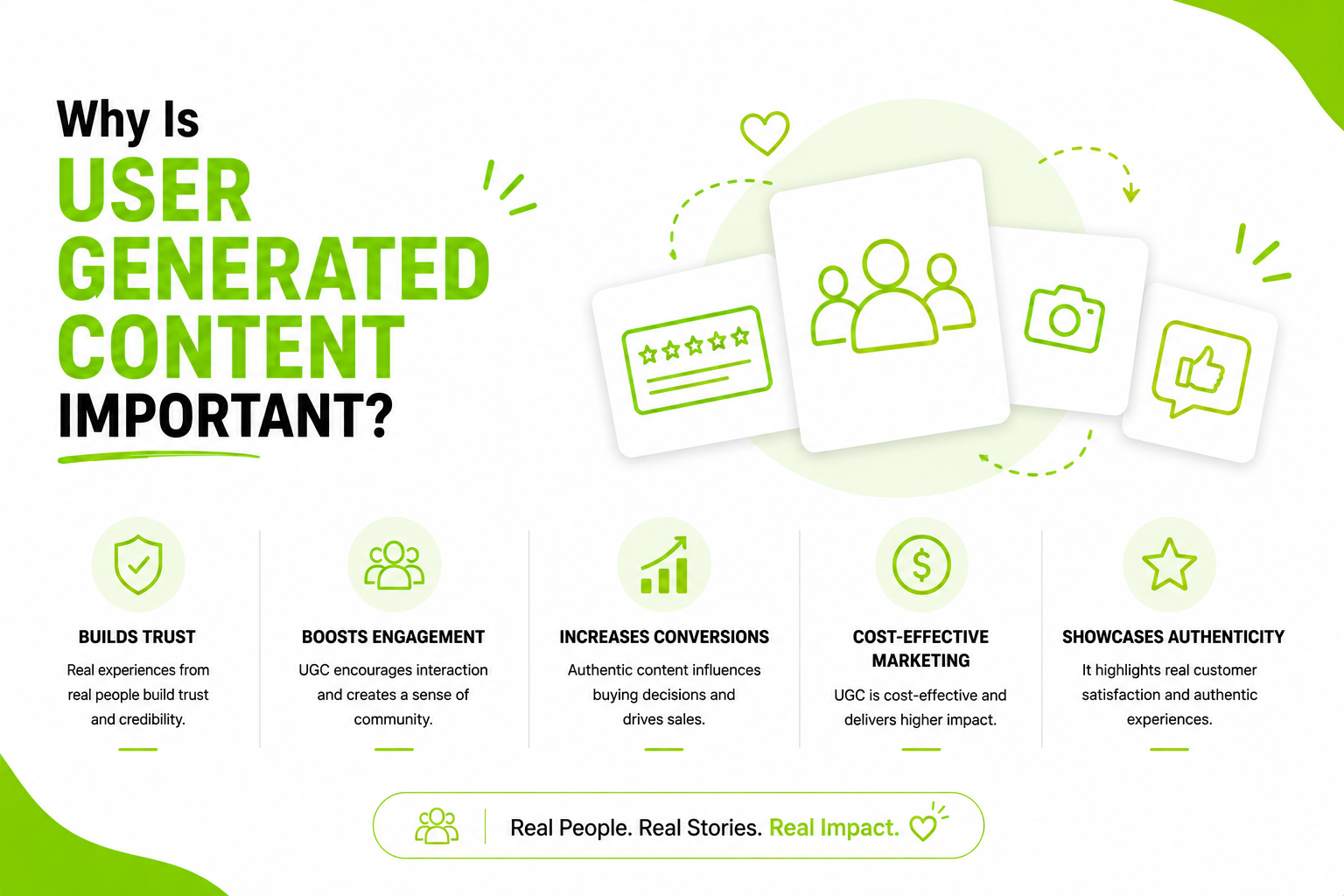
Modern consumers are exposed to advertisements every day. Because of this, they can sometimes become less responsive to traditional promotional messages.
User generated content provides a more authentic alternative. When potential customers see real people sharing their experiences, the content can feel more relatable and trustworthy.
1. Builds Customer Trust
Trust is one of the most important factors in purchasing decisions. Customers want to know whether a product actually works before spending money on it.
User generated content can provide real-world evidence. A customer review, product demonstration, or testimonial can help potential buyers understand what they can realistically expect.
When people see genuine experiences from other customers, they may feel more confident about a brand.
2. Creates Social Proof
Social proof is the idea that people are influenced by the actions and opinions of others.
For example, when a potential customer sees hundreds of positive reviews or several customers posting about the same product, it can create a sense of credibility.
User generated content acts as social proof because it demonstrates that real people are interacting with the brand.
3. Increases Engagement
UGC can encourage customers to actively participate in a brand’s community.
Businesses can create campaigns that ask customers to share photos, videos, reviews, or experiences using a specific hashtag. These campaigns can generate conversations and increase interaction across social media platforms.
Instead of simply talking to customers, brands can create opportunities for customers to participate.
4. Makes Marketing More Authentic
Traditional advertising often focuses on carefully produced visuals and promotional messages. While professional content has its place, customers may sometimes prefer content that feels natural.
A simple customer-created video can feel more authentic than a highly produced advertisement because it shows the product in a real-life situation.
This authenticity can help businesses create stronger connections with their audiences.
5. Provides More Marketing Content
Creating fresh content regularly can be challenging for businesses. UGC can provide additional content that can be used across different marketing channels, provided the business has permission from the creator.
For example, an approved customer video could potentially be featured on social media, a website, an email campaign, or a paid advertisement.
This allows brands to build a larger content library while maintaining a customer-focused approach.
Types of User Generated Content
There are several types of user generated content that businesses can include in their marketing strategy.
Customer Reviews
Reviews are one of the most common and useful forms of UGC. Customers can describe their experience with a product or service and share their opinions with potential buyers.
Businesses can highlight genuine reviews on product pages, social media, and other marketing materials.
Social Media Posts
Customers frequently share their experiences with brands on platforms such as Instagram, Facebook, YouTube, and TikTok.
A customer might post a photograph, short video, story, or written recommendation. With proper permission, brands can reshare this content.
Customer Videos
Video is one of the most engaging forms of content. Customers can create tutorials, demonstrations, reviews, or experience-based videos.
For example, a customer might record a short video explaining how they use a software product or demonstrate how they use a particular physical product.
Testimonials
Testimonials allow customers to explain how a product or service helped them.
Written testimonials can be displayed on websites, while video testimonials can be used in social media campaigns and landing pages.
Unboxing Content
Unboxing videos show customers opening and exploring a product for the first time.
This type of content can generate excitement because viewers get to see the product from a customer’s perspective.
Customer Stories
Longer customer stories can provide more detailed information about a person’s experience with a business.
These stories can be particularly useful for service-based companies because they can explain the customer’s problem, experience, and outcome.
How to Create an Effective User Generated Content Strategy

A successful UGC campaign requires planning. Simply asking customers to create content may not produce consistent results. Businesses need to provide clear reasons and simple opportunities for customers to participate.
Step 1: Define Your Objective
Start by deciding what you want to achieve.
Your objective could be:
- Increasing brand awareness
- Building customer trust
- Improving engagement
- Generating product reviews
- Increasing conversions
- Creating social media content
- Promoting a new product
Having a clear objective makes it easier to measure the success of your campaign.
Step 2: Understand Your Audience
Before creating a UGC campaign, understand your target audience.
Consider what platforms they use, what type of content they enjoy, and what motivates them to participate.
For example, a younger audience may prefer short-form videos, while another audience may respond better to written reviews or customer stories.
Step 3: Give Customers a Reason to Participate
Customers need a reason to create and share content.
Businesses can encourage participation through:
- Contests
- Challenges
- Recognition
- Community features
- Product launches
- Branded hashtags
- Exclusive experiences
However, participation should feel natural rather than forced.
Step 4: Make It Simple
The easier your campaign is to understand, the easier it is for customers to participate.
Instead of giving customers complicated instructions, provide a simple idea.
For example, a business could ask customers to share a photo showing how they use a product and include a specific hashtag.
Step 5: Encourage Authentic Content
The biggest advantage of user generated content is authenticity. Businesses should avoid turning every customer post into a polished advertisement.
Allow customers to express their genuine opinions and experiences.
Authentic content can often feel more relatable than content that looks overly promotional.
Step 6: Ask for Permission
One of the most important steps in using UGC is obtaining appropriate permission.
A customer posting something publicly does not automatically mean a business can use it everywhere for marketing purposes.
Before republishing customer-created content, brands should clearly request permission and follow applicable platform rules and copyright requirements.
Step 7: Give Credit
When sharing customer content, credit the original creator where appropriate.
Tagging or mentioning the creator can show appreciation and encourage other customers to participate.
It also helps strengthen the relationship between the brand and its community.
How User Generated Content Supports Digital Marketing
User generated content can support several areas of digital marketing.
Social Media Marketing
UGC can help businesses maintain an active social media presence. Customer photos, reviews, videos, and stories can provide additional content ideas while encouraging community interaction.
Content Marketing
Brands can incorporate customer stories and experiences into their broader content strategy.
For example, a business could create an article based on common customer questions and include relevant customer experiences.
Video Advertising
Customer-created videos can be particularly valuable for video advertising. With appropriate permission, businesses can use authentic customer experiences as part of advertising campaigns.
This can make advertisements feel more relatable and less like traditional promotional content.
Influencer Marketing
Influencers and creators can also generate content around products and services. While influencer content and UGC are not exactly the same, both can help brands connect with audiences through people rather than relying only on brand-created messaging.
Website Marketing
Reviews, testimonials, customer photographs, and videos can be incorporated into website pages.
Displaying genuine customer experiences can help visitors understand the value of a product or service.
Best Practices for User Generated Content
To get better results from UGC, businesses should follow several best practices.
Focus on authenticity: Let customers share genuine experiences rather than forcing them into a strict advertising format.
Make participation easy: Simple campaigns generally provide a better experience for customers.
Use clear guidelines: Explain what type of content you are looking for without limiting creativity too much.
Ask for permission: Always obtain appropriate permission before using customer content in your marketing.
Give creators credit: Recognize the people who contribute valuable content.
Choose quality over quantity: A few relevant and authentic posts can be more valuable than a large amount of low-quality content.
Measure performance: Track engagement, reach, conversions, clicks, and other relevant metrics.
Common User Generated Content Mistakes
Although UGC can be powerful, businesses can make mistakes when using it.
One common mistake is making customer content look too much like a traditional advertisement. The purpose of UGC is to provide a genuine customer perspective.
Another mistake is using content without permission. Businesses should always respect creator rights and obtain appropriate approval.
Ignoring negative feedback is another problem. Not every customer experience will be positive. Instead of deleting legitimate criticism, businesses should use feedback as an opportunity to improve customer service and products.
Finally, businesses should avoid creating campaigns that are unnecessarily complicated. Customers are more likely to participate when the process is clear and easy.
How to Measure the Success of UGC
Businesses should measure the performance of their UGC campaigns using relevant metrics.
Some useful metrics include:
- Engagement rate
- Reach
- Impressions
- Website traffic
- Click-through rate
- Conversion rate
- Sales
- Number of submissions
- Customer reviews
- Brand mentions
The right metrics depend on the goal of the campaign.
For example, if the goal is brand awareness, reach and impressions may be important. If the goal is sales, conversions and revenue may be more useful.
The Future of User Generated Content
The importance of user generated content is likely to continue as consumers increasingly look for authentic and relatable brand experiences.
Short-form video, customer reviews, social media communities, and creator-driven content are becoming important parts of how people discover products and services.
Businesses that successfully encourage their customers to participate in brand storytelling can create stronger communities and more authentic marketing experiences.
As digital platforms continue to evolve, UGC can also become increasingly integrated with advertising, ecommerce, social media, and content marketing.
Conclusion
User generated content is more than just customer-created posts. It is a powerful way for businesses to build trust, demonstrate social proof, increase engagement, and create authentic connections with their audiences.
From customer reviews and testimonials to social media posts and videos, UGC can support almost every stage of the digital marketing journey.
The key is to keep the strategy authentic, make participation easy, respect customer rights, and focus on content that genuinely provides value.
For businesses looking to strengthen their online presence, incorporating user generated content into their digital marketing strategy can be an effective way to turn satisfied customers into valuable brand advocates.
SEO Details
Focus Keyword: User Generated Content
SEO Title: User Generated Content: A Complete Guide for Businesses
Meta Description: Learn what user generated content is, why UGC is important, its different types, and how businesses can use UGC to build trust, engagement, and brand awareness.
Suggested URL Slug: user-generated-content-guide
Suggested Secondary Keywords:
- user generated content marketing
- UGC marketing
- benefits of user generated content
- types of user generated content
- UGC strategy
- customer generated content
- user generated content examples
Lorem ipsum dolor sit amet, consectetur adipiscing elit. Ut elit tellus, luctus nec ullamcorper mattis, pulvinar dapibus leo.